Adelhills Bengals
Bengal Cattery · Adelaide Hills
Replaces spreadsheets, paper records, and scattered emails for a registered Bengal breeder with one integrated system covering the full lifecycle from pairing to placement.
Context
Adelhills Bengals is a registered Bengal and Cashmere Bengal breeder in the Adelaide Hills. The platform operates three integrated portals: a public-facing website showcasing cats and taking kitten applications, a buyer portal where approved customers track their kitten's journey, and an admin dashboard where the breeder runs the entire operation — pairings, litters, health records, applications, sales, and finances.
The Problem
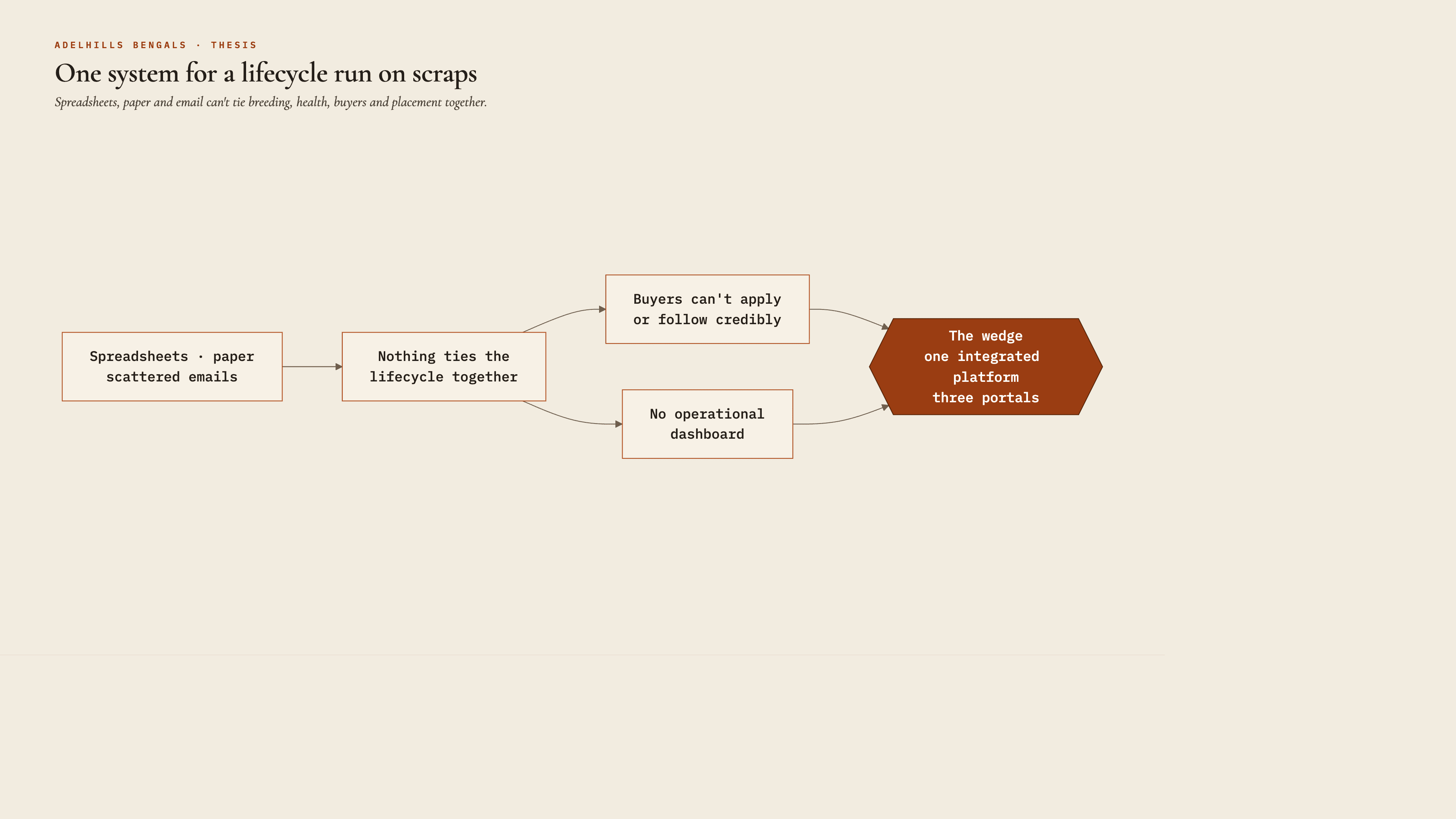
The cattery ran on spreadsheets, paper records, and scattered emails, with no single system tying together breeding planning, health testing, buyer applications, and placement. Prospective buyers had no consistent, credible way to apply or follow their kitten, and the breeder had no operational dashboard.
Constraints
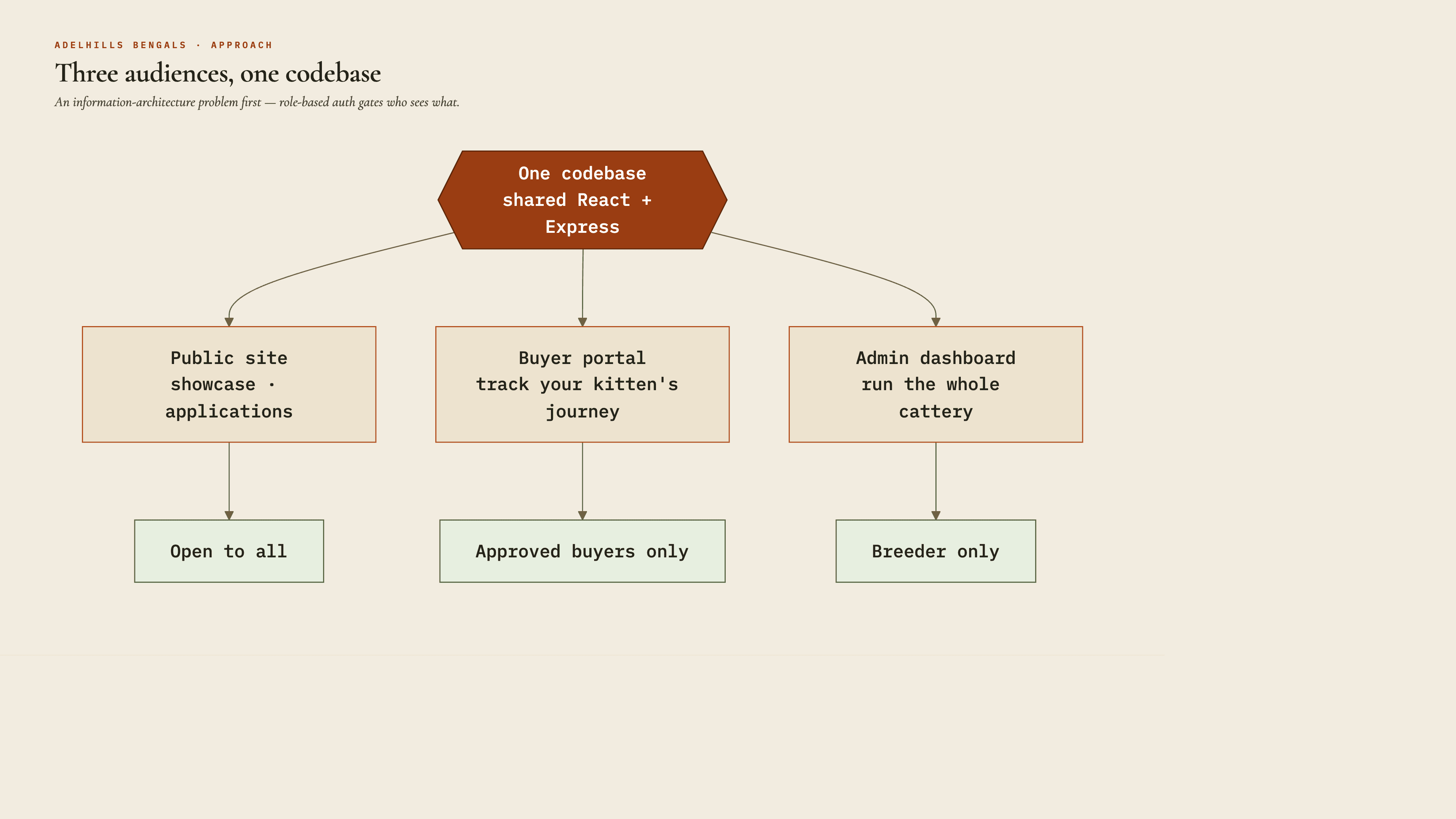
One codebase had to serve the public, approved buyers, and the breeder/admin — each with different access and needs.
The public site has to convey credibility (pedigrees, health badges, testimonials) to families making a long-term decision.
A solo-maintainable system — a JSON file store with file-locking rather than a database — kept ops overhead low for a single breeder.
Strategic Approach
A modular three-portal architecture on a shared React frontend and Express backend, with role-based auth protecting the buyer and admin areas. The public site leads with trust signals; the buyer portal gives a personal journey view; the admin dashboard consolidates the full lifecycle into one operational surface.
Execution
Public Site
Built the homepage, filterable cat/kitten/stud/queen galleries, detailed profiles with pedigree trees and health badges, and a three-track application hub.

Buyer Portal
Delivered an approved-buyer dashboard with a kitten summary, photo gallery, and a timeline of updates.
Admin Dashboard
Shipped cattery operations — cat and litter management, buyer applications, health testing schedules, sales, and a breeding calendar.

Data & Auth
Implemented a file-locked JSON store, role-based authentication, image processing, and transactional email.

Outcomes
Shipped three integrated portals on one codebase: a public site, an approved-buyer portal, and a complete cattery operations dashboard.
Impact
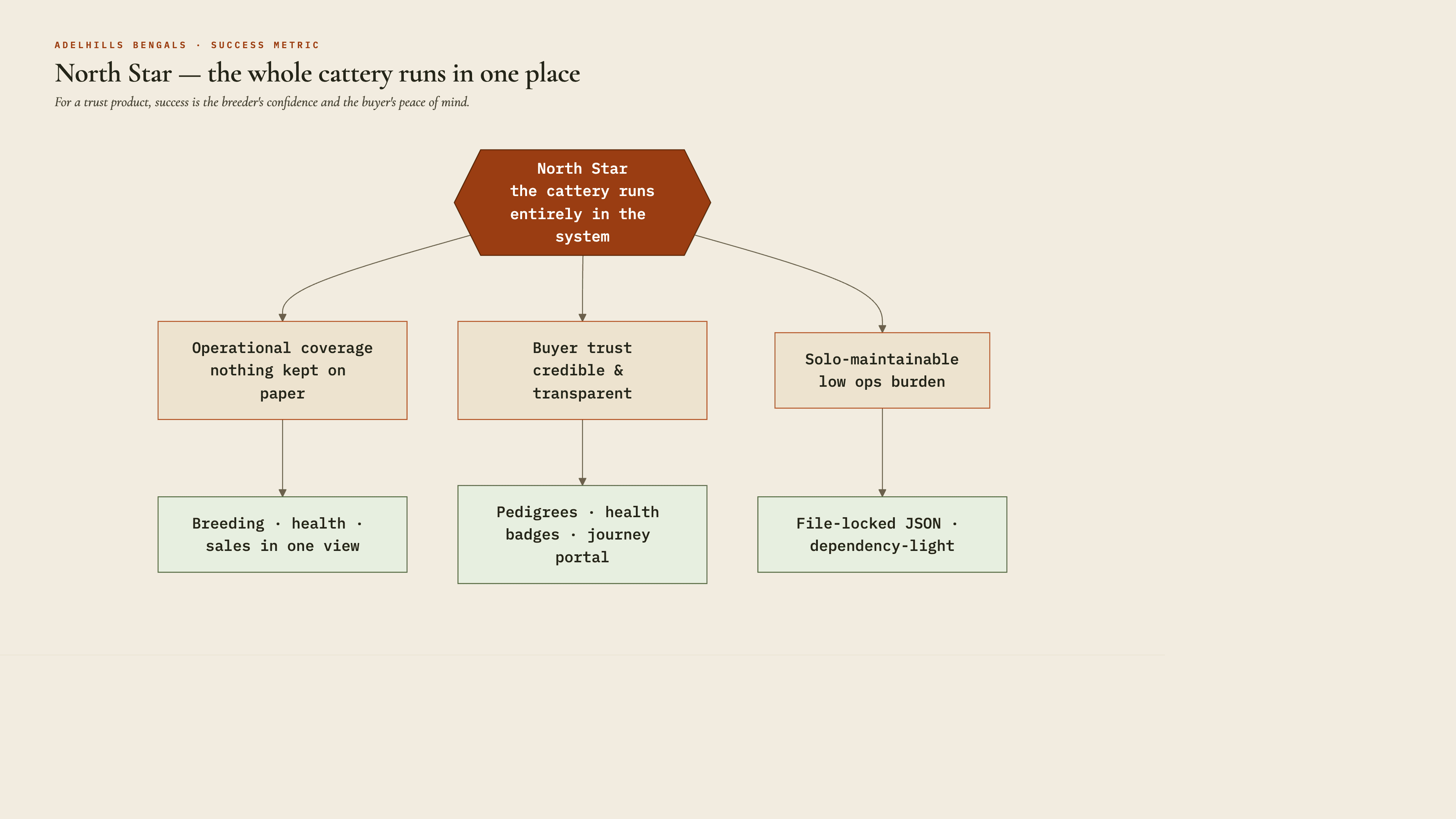
- •Gave a working breeder a single operational dashboard for the whole cattery.
- •Built buyer trust with pedigrees, health badges, and a personal kitten-journey portal.
- •Kept the system solo-maintainable by choosing a pragmatic, dependency-light stack.
Reflections
Decisions, tradeoffs, and what I'd change.
- 01
Made a deliberate dev-mode call: get a complete, usable UX in place first and backlog security, auth hardening, and performance — the right sequencing for a pre-launch client tool, with the risks written down rather than hidden.
- 02
Chose a file-locked JSON store over a database because the system serves one breeder (~60 cats); SQLite is the documented upgrade path for when it outgrows that.
- 03
Three audiences (public, buyer, admin) on one codebase is an information-architecture problem first — role-based auth is scoped as the next build, not a launch blocker.
Gallery

The domain: every lifecycle stage — pairing to placement — captured in one operational surface.

And it ships: the public site leads with trust signals — pedigrees, health badges, testimonials.