Blue Dwarf
Aerospace Mission Control · Blue Dwarf Technologies
For aerospace operators running launches under heavy regulatory load — readiness, trajectory, and compliance status on a single go/no-go surface. Built by a six-person team and in production.
Context
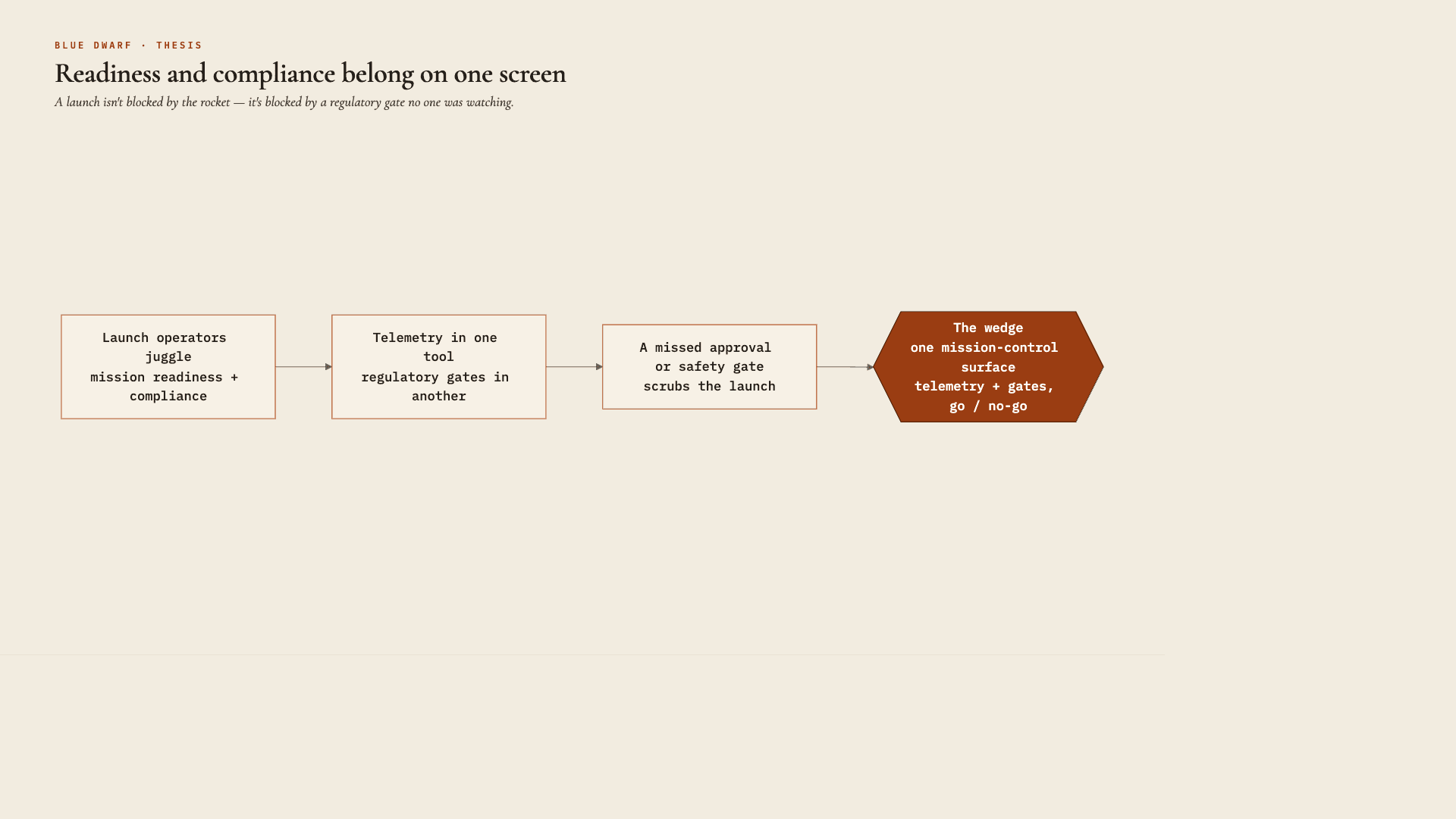
Blue Dwarf is a mission-control platform for aerospace launch operators. One surface brings together live mission parameters (launch window, payload, fuel), orbital trajectory (altitude, inclination, maneuvers), and a first-class compliance panel — regulatory approvals, launch-site safety, communication protocols, and environmental impact. I worked as a product designer and engineer on a six-person team, and the platform is in production with aerospace operators.
The Problem
Launch operations are gated as much by regulation as by engineering: approvals, safety sign-offs, comms protocols, and environmental clearances all have to hold before a window opens. When that status lives in documents separate from live mission telemetry, a single missed gate can scrub a launch. Operators needed one surface where readiness and compliance are visible together, with an unambiguous go/no-go read.
Constraints
A stale or misread status can scrub a launch — every gate has to be accurate, current, and unambiguous.
Decisions happen against a countdown, so the interface has to answer 'are we go?' at a glance rather than bury it.
Six people building in parallel — a shared design system was the only way to keep one coherent surface.
A live operational tool with real operators, not a demo — it had to hold up in real use.
Strategic Approach
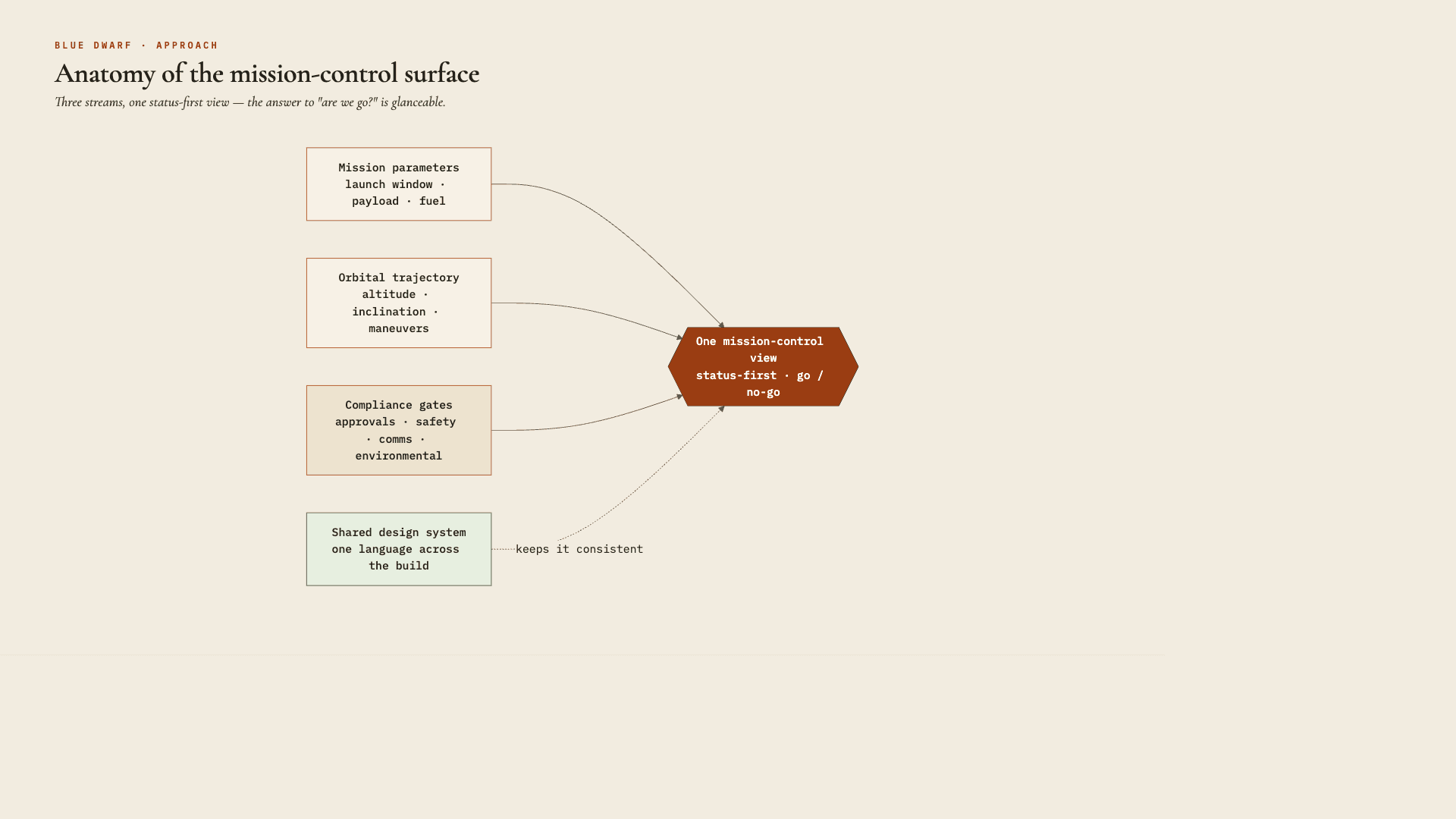
Treat the mission-control view as a single status-first surface: three streams — mission parameters, orbital trajectory, and compliance gates — resolve into one go/no-go read. Make compliance a first-class panel rather than a buried checklist, with explicit per-gate status semantics (e.g. COMPLIANT, SECURE, CLEARED) instead of a single pass/fail. Anchor the whole build on a shared design system so a six-person team ships one coherent product.
Outcomes
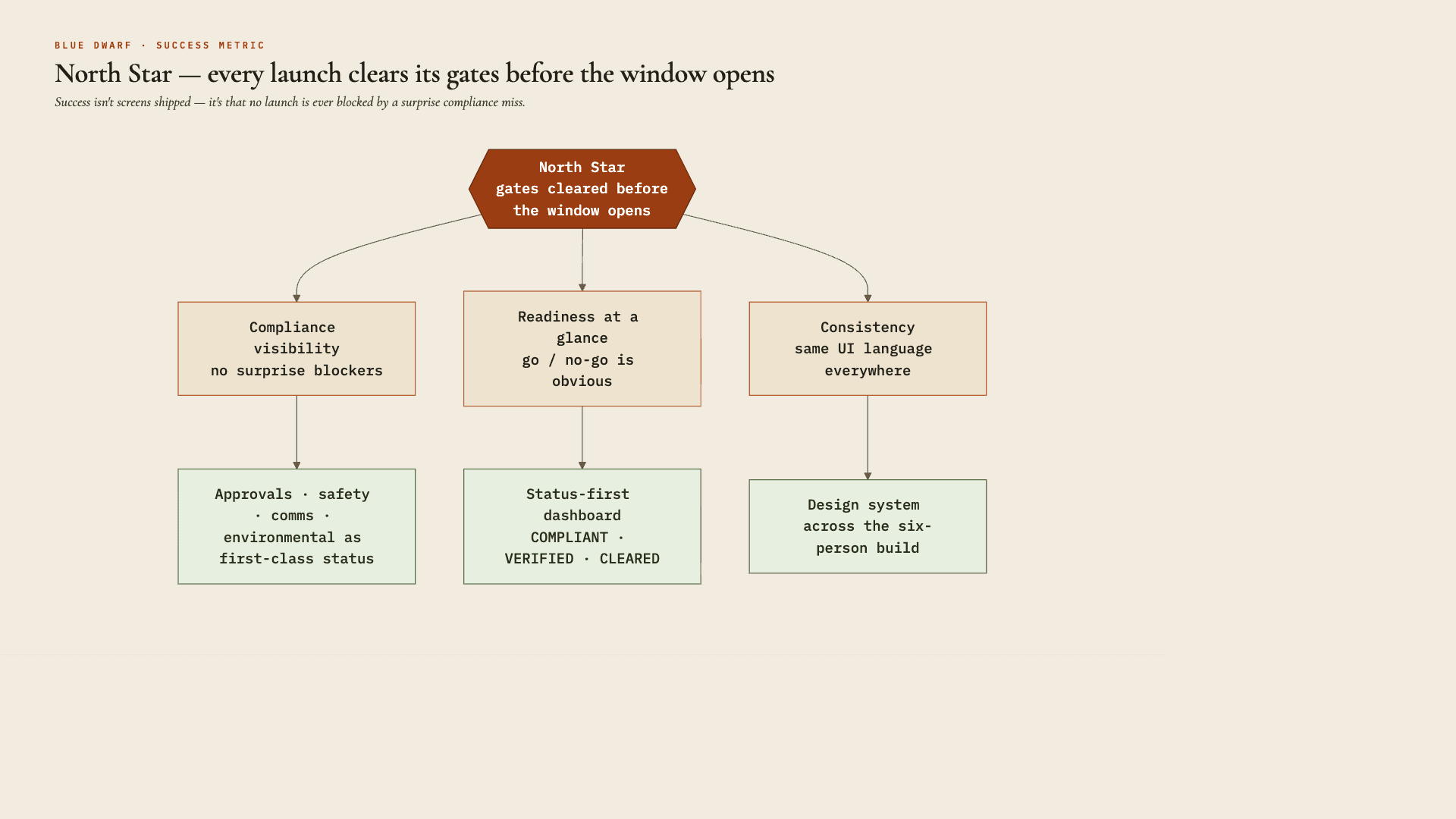
Shipped a production mission-control surface for aerospace operators — readiness telemetry and regulatory compliance gates unified into one go/no-go view, held together by a design system across a six-person build.
Impact
- •In production with aerospace operators — a live operational tool, not a concept.
- •Put regulatory compliance on the same screen as mission readiness, so go/no-go is a single glance.
- •Kept a six-person build coherent through a shared design system, owned end to end.
Reflections
Decisions, tradeoffs, and what I'd change.
- 01
On a six-person team, the design system is the highest-leverage thing a designer owns — it's how five other people stay consistent without a meeting for every decision.
- 02
In a high-stakes, regulated domain, clarity beats cleverness: the real win was making 'are we go?' unambiguous, not making it pretty.
- 03
Compliance is a product surface, not an afterthought — making approvals and safety first-class status was a deliberate IA decision to put the regulatory read on equal footing with telemetry.
Gallery

Designing for the domain: when a wrong read scrubs a launch, clarity beats cleverness — and a design system keeps six people consistent.

And it ships: the production dashboard — mission parameters, orbital trajectory, and a first-class compliance panel (approvals, safety, comms, environmental).