WorkspaceIQ
Team Knowledge Platform
For small cross-functional teams drowning in scattered inputs across email, calendar, notes, and shared docs. Everything scopes to a project, so one client's context never bleeds into another's.
Context
WorkspaceIQ is a recall and orientation platform for small project teams (2–10 people). It indexes every email, doc, meeting, and calendar event so a team can ask plain-English questions and get cited answers from their own history, surface commitments before they're missed, and run recurring client work on autopilot — all scoped to a project so Client A never bleeds into Client B.
The Problem
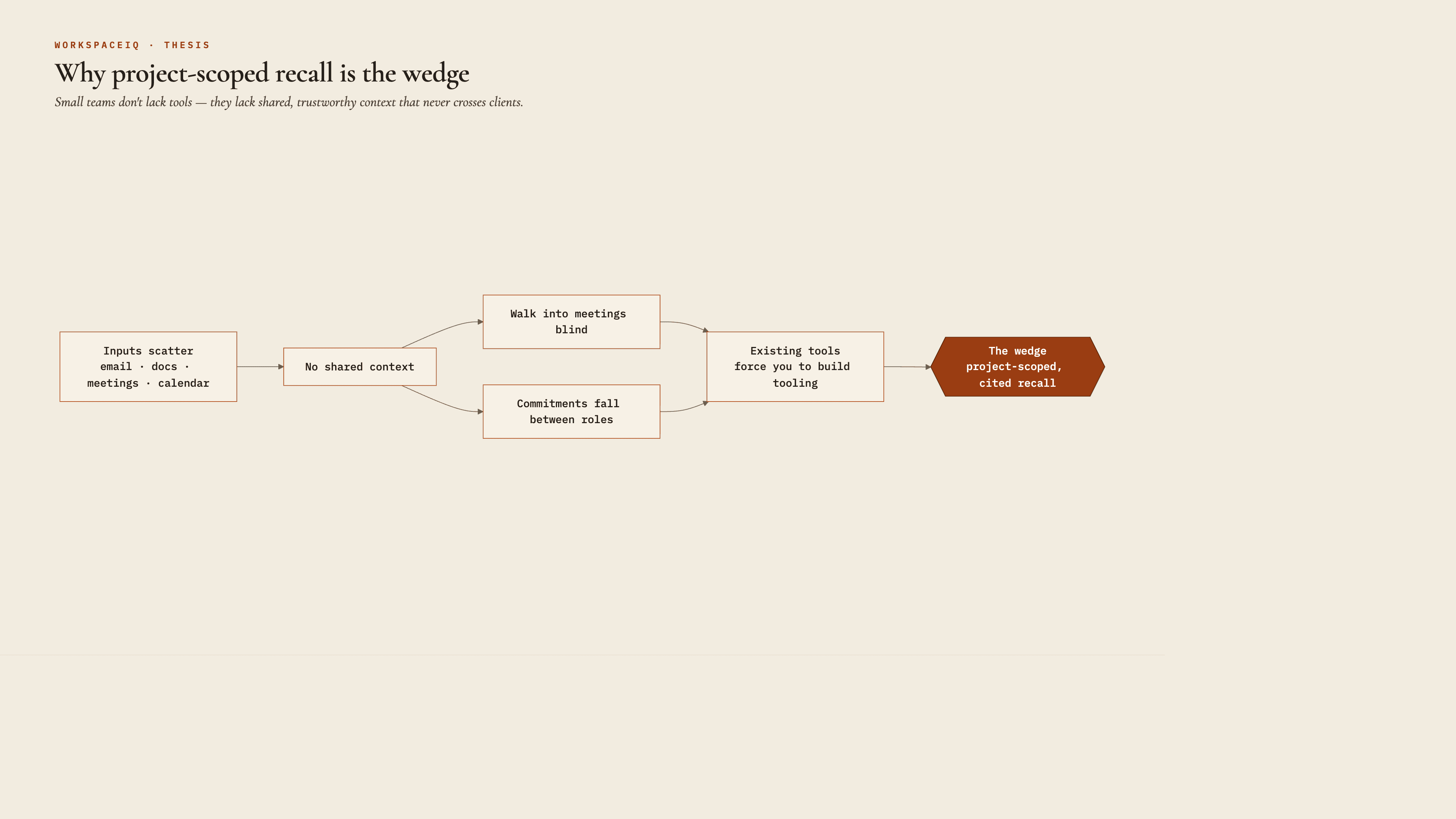
Small cross-functional teams are drowning in scattered inputs spread across people and tools. They need shared context so no one walks into a meeting blind and nothing falls between roles. No existing product gives them a single, project-scoped view of what's urgent and due without forcing them to build new tooling.
Constraints
Explicit non-goals — no drafting, no synthesis-for-its-own-sake, no external write-back, no governance theater — to prevent feature creep.
Project separation had to be enforced at query time, not just in the UI, so client contexts can never cross-contaminate.
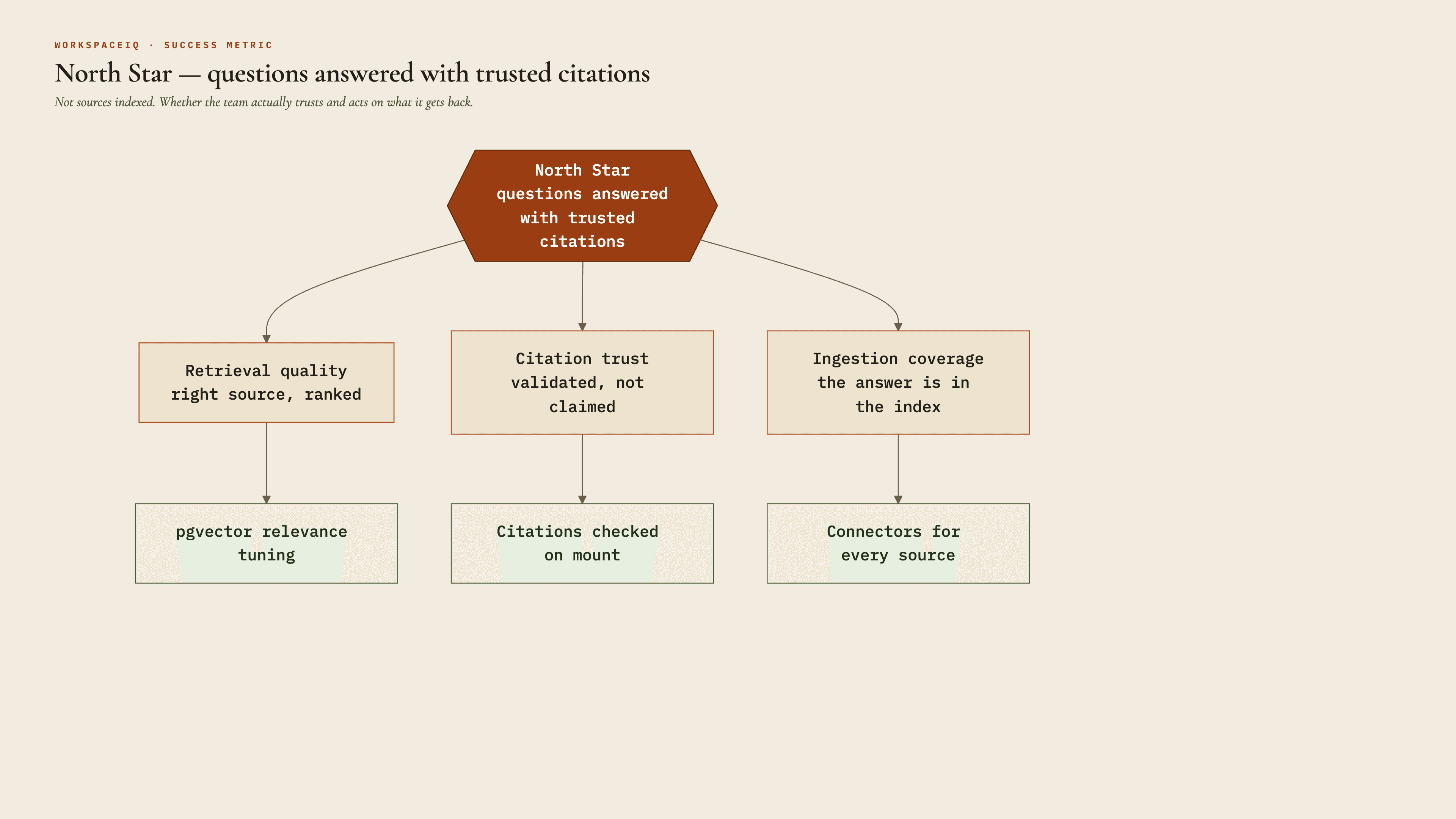
Every answer needs validated citations on mount so users can verify the source, not just read a confident paragraph.
Connectors for Gmail, Drive, Notion, Calendar, and uploads had to normalize wildly different formats into one searchable store.
Strategic Approach
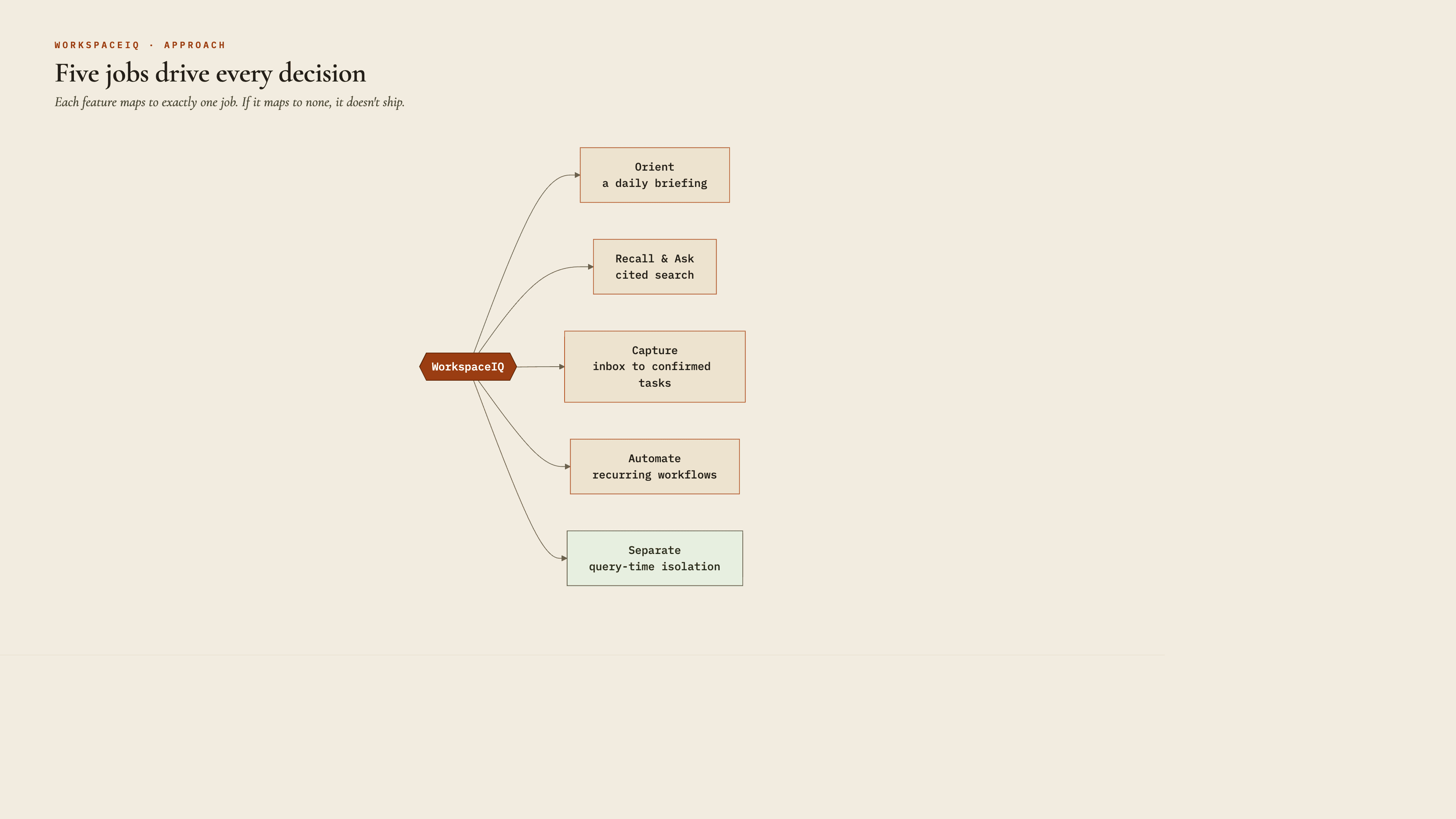
Five core jobs drive every decision: Orient (a daily briefing), Recall & Ask (cited search), Capture (inbox triage into confirmed tasks), Automate (recurring workflows on a schedule), and Separate (project isolation). The information architecture shifted from flat collections to hierarchical projects, with a cross-project library for reusable methodology templates.
Execution
Retrieval & Ingestion
Built connectors and a pgvector-backed search over 700+ sources with real SSE streaming, per-token flushing, and citation validation on mount.

Capture
Designed inbox-to-task triage with a detail drawer, bulk accept/reject with confirmation, and a pending-review state for auto-detected tasks.
Automate
Shipped per-project default workflows (task extraction + daily briefing), schedule badges, context variables substitutable into prompts, and failure notifications.
Design System
Established a tiered system — a shared PageShell, five page archetypes, and responsive density scaling for 13–14" laptops.
Outcomes
Shipped a project-scoped assistant — now in daily production use across three teams: a farm operation, an architecture practice, and the studio's own office.
Impact
- •Proven in production across three very different teams — farming, architecture, and studio ops — not a single friendly test group.
- •Gave small teams one project-scoped surface for what's urgent, due, and already known.
- •Kept the product sharp by enforcing explicit non-goals against feature creep.
- •Made answers trustworthy by validating citations up front instead of after a click.
Reflections
Decisions, tradeoffs, and what I'd change.
- 01
Non-goals are a design tool — I modeled the grounding on NotebookLM (chat is read-only retrieval, the briefing never drafts a sentence) and had the build push back on any request that broke those rules.
- 02
Project isolation has to be enforced at query time, not just the UI — I caught roughly 900 sources leaking into a single project during testing, which is exactly why scope is now locked at retrieval.
- 03
The honest state: I catch regressions by manual testing because coverage is thin, and the agentic-RAG migration is designed but not yet built — a planned next step, not a shipped win.
Gallery

Scope discipline: non-goals are a design tool — the build pushes back on anything that breaks them.

And it ships: cited answers drawn from your own email, docs, calendar, and Notion.